For decades, businesses have planned around a simple equation: how much work do we have, and how many people do we need to do it?
That equation is breaking down. Work is now done by a mix of employees, contractors, outsourcing partners, automation, AI copilots, and autonomous AI agents. Managing that mix is a different problem.
The old question was “How many people do we need?” The better question is “How much capacity do we need, and what mix of human and digital resources should deliver it?”
Moving from headcount management to capacity management may be one of the most important operating changes of the AI era.
Work Needs a Common Measure
Organizations measure people well. They track headcount, salaries, contractor spend, overtime, productivity targets, occupancy, and staffing ratios.
AI doesn’t fit those measures. An agent can run around the clock, process thousands of documents, flag exceptions, draft communications, and finish parts of a process before the workday starts.
Speed alone can’t define capacity, though. A fair measure also has to account for quality, accuracy, autonomy, complexity, risk, and how much human supervision the work still needs.
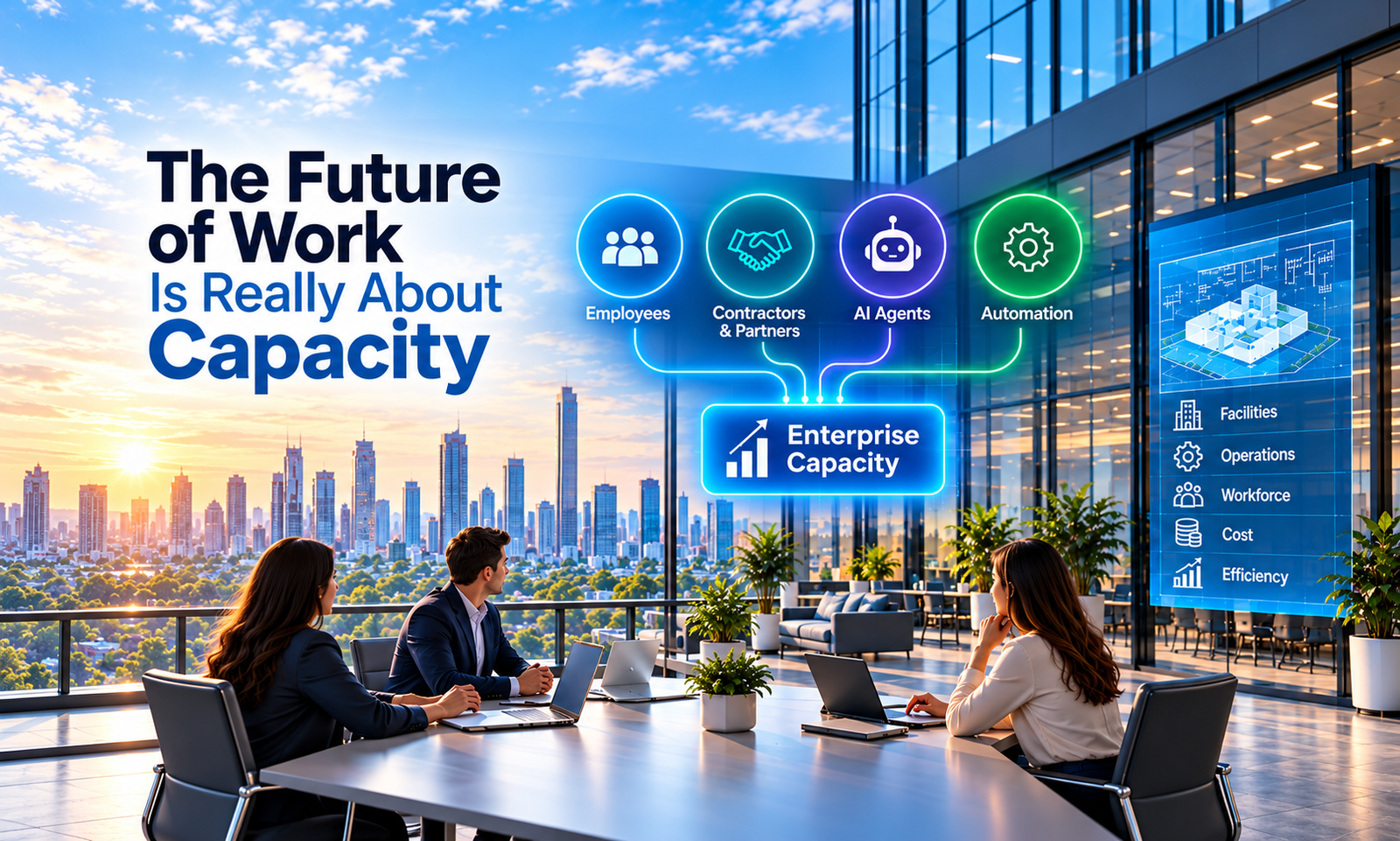
Picture a common capacity unit: a defined amount of productive work at an agreed quality level. Employees, contractors, outsourcing partners, and AI agents each contribute units. Once every resource is normalized to the same measure, workforce planning gets much sharper.
Leaders stop saying “we need 100 more employees.” They say “we need 100 more units of capacity.” Those units might come from 40 new hires, a few redesigned processes, AI agents, an expanded outsourcing partnership, and retrained staff moving into higher-value work.
That’s a different conversation, and often a cheaper one.
Every Body of Work Needs a Delivery Strategy
AI lets organizations rethink who, or what, should do each task. Not every activity belongs with an AI agent. Not every one needs a full-time employee, an outsourcing partner, or automation either.
Making those calls well takes a workforce-mix framework. It should weigh each body of work on cost, productivity, quality, risk, complexity, judgment, customer impact, regulatory requirements, and scalability. From there, leaders can choose a delivery model on purpose.
| Type of work | Likely delivery model |
|---|---|
| Repetitive, rules-based | Automation or AI agents |
| Variable, transactional | Outsourcing partners |
| Specialized, short-term | Contractors |
| Judgment, relationships, creativity, accountability, leadership | Primarily human |
| Mixed | Hybrid: an agent researches, prepares, or flags; a person decides |
Many processes will land in that last row. The goal is simple: put each piece of work where it gets done best.
Facilities Belong in the Same Equation
Workforce, facilities, technology, and finance have usually been planned separately. AI gives organizations a reason to connect them.
If automation cuts manual processing at a site, does the site still need the same footprint? If employees spend less time on admin and more on collaboration, customers, and exceptions, should the workspace change too?
Other questions follow:
- Can AI schedule staff against demand patterns?
- Can occupancy and workforce data together show how space is really used?
- Can predictive systems catch maintenance needs before equipment fails?
- Can digital agents coordinate service requests, vendors, inspections, inventory, and energy use?
- Can leaders model labor capacity, facility capacity, customer demand, and operating cost before committing capital?
The bigger opportunity is a smarter operating system for the whole enterprise. It would show leaders whether the next dollar belongs in people, technology, automation, physical space, external partners, or some combination.
AI Changes Tasks Before It Changes Jobs
Organizations often think about AI one job at a time. Jobs are bundles of tasks, and AI usually reshapes the tasks first.
Take a role that splits its time like this:
| Activity | Share of time |
|---|---|
| Gathering information | 30% |
| Preparing reports | 20% |
| Answering routine questions | 20% |
| Solving complex problems | 20% |
| Coaching and collaborating | 10% |
If AI absorbs most of the first three, the result isn’t the same job done faster. It’s a different job. The person spends more time on problems, decisions, process improvement, relationships, and running AI-enabled workflows.
Roles have to be redesigned while AI is deployed, not after. Otherwise the technology changes and the process changes, but the organization stays the same. Many efficiency efforts stall right there.
The Skills Conversation Has to Change
New work calls for new skills, and technical AI expertise is only part of it. People need to work with intelligent systems: frame problems, check AI output, spot errors, read data, redesign workflows, handle exceptions, and know when a human has to step in.
AI fluency can’t be a one-time training course. It has to become an organizational capability.
- Managers need to understand how AI changes workforce design.
- Employees need to understand how it changes their work.
- Leaders need to know where it creates value and where it adds risk.
Career paths should reward skills that didn’t exist when today’s job descriptions were written. Over time, planning may shift from roles to skills. Instead of asking “What positions do we need?” leaders will ask “What capabilities do we need access to?” The wording change is small. The implications are large.
The Real Opportunity Is Redesign
Most of the attention right now is on AI tools. The bigger gains will likely come from asking why a process exists in its current form at all.
Say AI can automate six steps of a ten-step workflow. The instinct is to automate those six. The better question is whether the workflow still needs ten steps.
With AI, it might need four. Information that moved through several teams could be evaluated at once. Approvals could become exception-based. Weekly reports could become continuously available. Three systems could become one workflow.
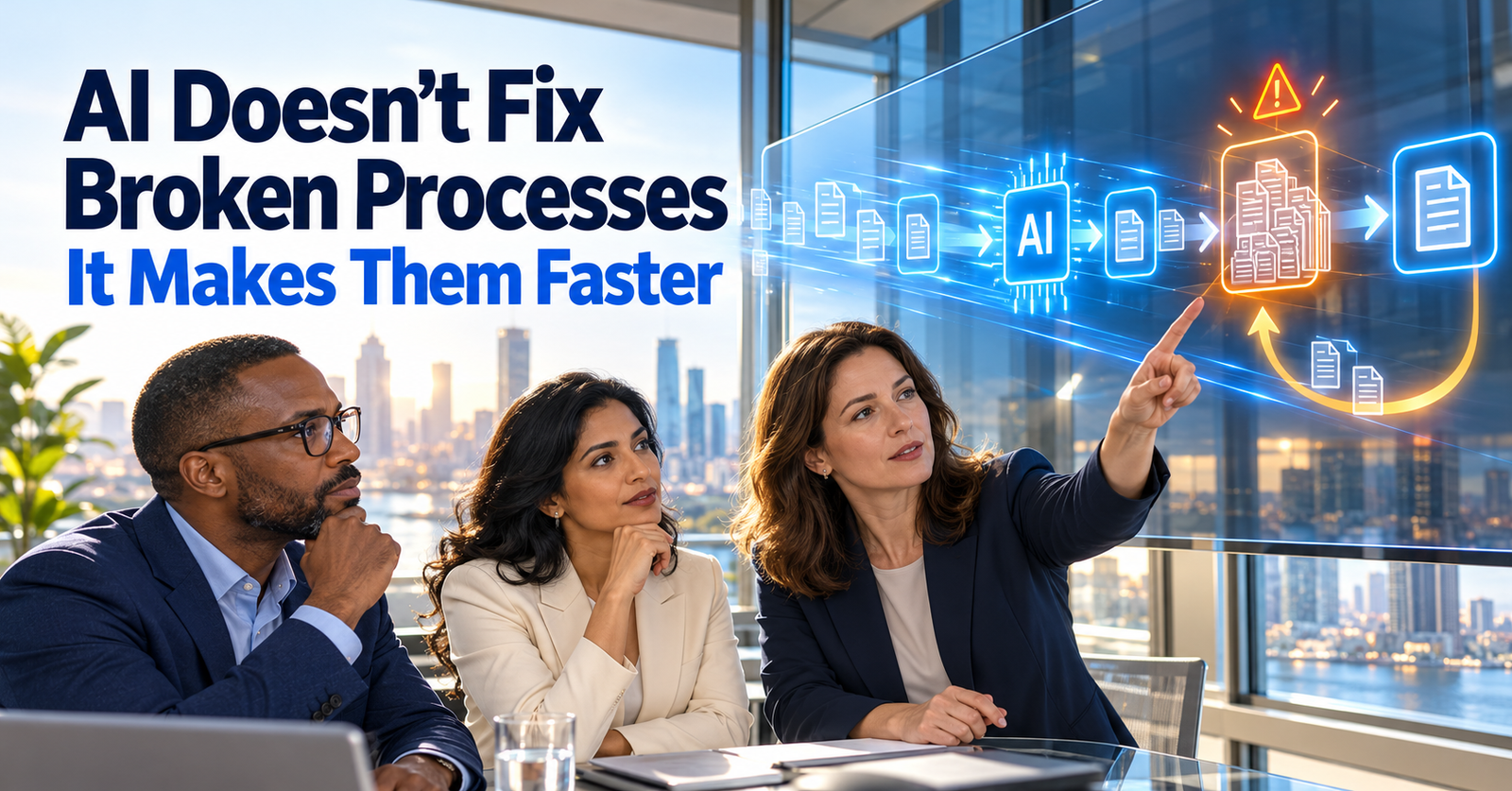
Automating a broken process just makes it faster. Redesigning it removes the waste.
Governance Must Grow With Capability
None of this works without governance. As AI takes a bigger role in workforce, operational, and business decisions, organizations need clear standards for privacy, fairness, security, explainability, accountability, and human oversight.
The more autonomous a system is, the more it matters where authority sits. Leaders should be able to answer:
- Who reviews the system’s decisions?
- What happens when it’s wrong?
- Which decisions need human approval?
- What data can it access?
- How is its performance monitored?
- How does it affect employees and customers?
Responsible AI can’t sit off to the side of the transformation. It has to be built into the architecture. Organizations that set governance early may move faster, because their boundaries for experimenting and deploying are already clear.
From Workforce Planning to Enterprise Capacity Planning
Today, HR plans the workforce. Finance plans capital. Operations plans demand. Technology plans systems. Facilities plans space. AI teams plan automation. The business feels all of it at once.
The opportunity is to plan it together. Imagine an annual cycle where leaders forecast demand, size the capacity needed to meet it, and test scenarios side by side:
- What if we hire, automate, outsource, or retrain?
- What if we redesign the process, or let AI agents absorb part of the load?
- What happens to facilities, customer experience, quality, and cost?
That goes well past traditional workforce planning. It’s enterprise capacity planning, and I believe that’s where many organizations are heading.
The companies that gain most from AI won’t necessarily deploy the most AI. They’ll be the ones that understand where people create the most value, where machines create the most leverage, and how the two should work together.
The future of business isn’t about fewer people or more technology. It’s about the right capacity, with the right skills, in the right place, at the right cost, with the right level of human judgment. Organizations that master that equation will do more than become efficient. They’ll become fundamentally more adaptable.