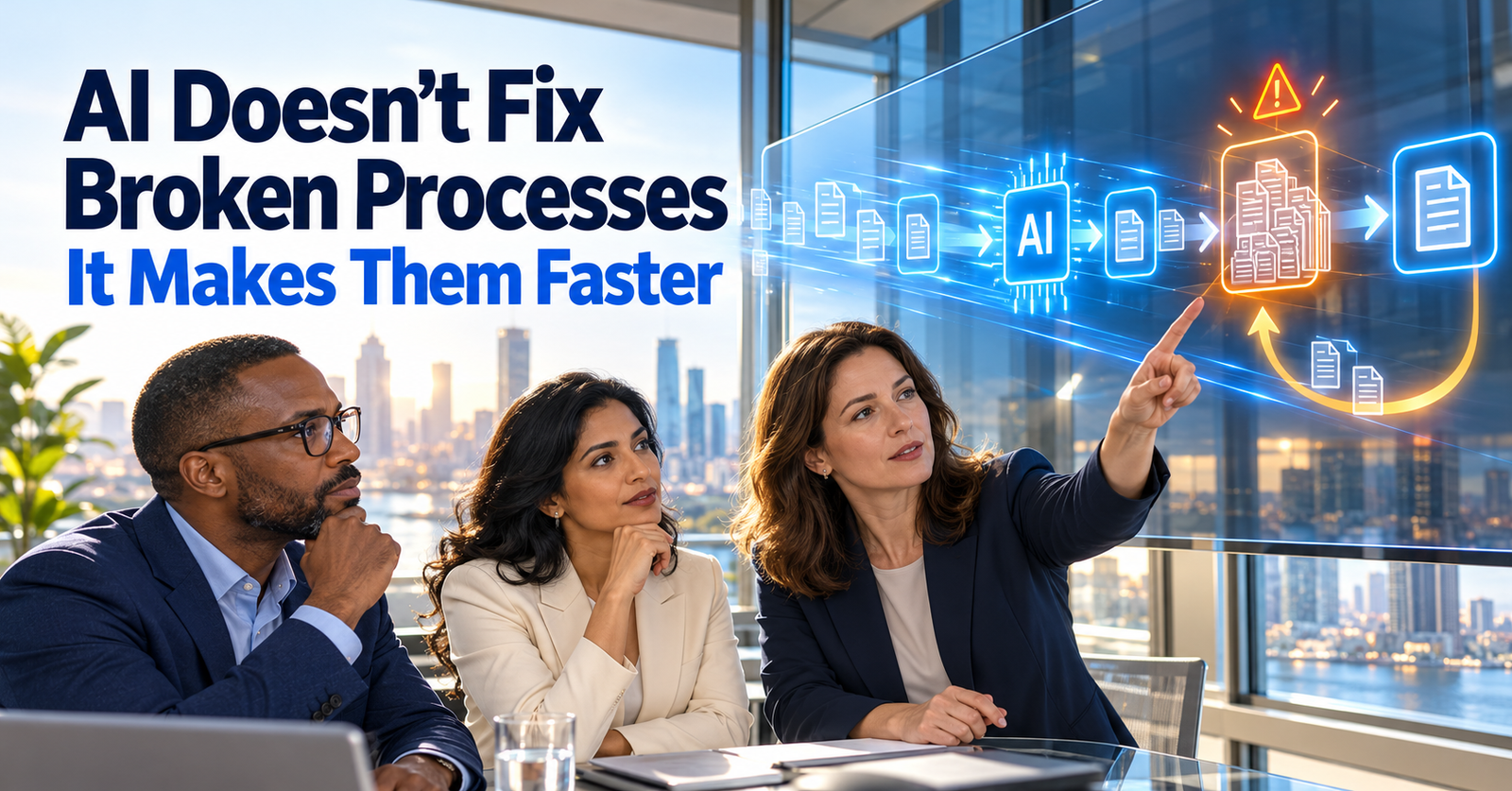
In March 2025, New York began asking employers filing layoff notices one extra question: did technological innovation or automation contribute? In the first year, more than 160 companies filed notices. None checked the box. [1]
That result can be read two ways. Either AI is not yet driving mass layoffs in New York, or it is, and employers are not saying so. Either way, the question was easy to skip. It was not written into the statute, and the state never defined what counted as “automation.”
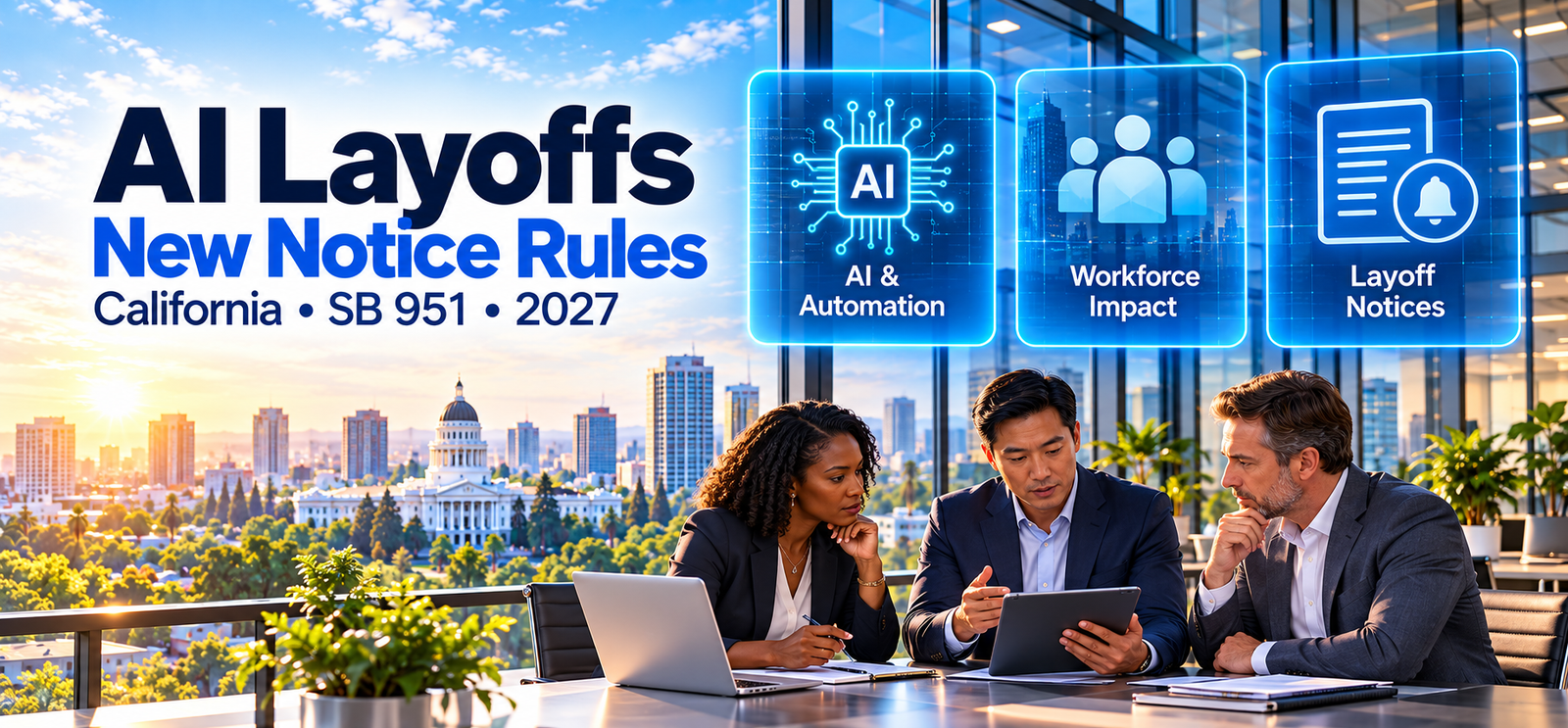
California is taking a firmer approach. Under SB 951, signed September 30, 2026, a Cal-WARN notice for a layoff caused in whole or in substantial part by AI or other automated technology must say so, at the top of the page, and describe what is being automated. The change takes effect January 1, 2027. [2–3]
For HR, legal and transformation leaders, the important point is not the extra paragraph in a notice. It is that the decision about whether a restructuring is “AI-driven” now has to be made, documented and defended during workforce planning, long before the notice is drafted.
This article reflects the chaptered text of SB 951 reviewed as of October 19, 2026. It is general information, not legal advice.
What SB 951 requires
SB 951 does not create a new notice regime. It adds content to the existing California WARN Act, so the familiar Cal-WARN triggers still decide whether a notice is due at all. [2]
| Element | What the law says |
|---|---|
| Who is covered | Employers with a “covered establishment”: an industrial or commercial facility that employs, or employed in the prior 12 months, 75 or more people. |
| What triggers a notice | A mass layoff (50 or more employees in a 30-day period), a relocation of 100 miles or more, or a termination (shutdown) of operations. |
| Timing and recipients | Unchanged: at least 60 days before the action, to affected employees, the Employment Development Department (EDD), the local workforce board, and local elected officials. |
| When the AI content applies | When the action is caused “in whole or in substantial part” by AI or other automated technology replacing or automating positions. |
| What the notice must add | (1) The number, classification or occupation, and work location of the positions affected; (2) the job functions being automated; (3) the category or type of AI or automated technology involved; and (4) a statement at the top: “This notice is for a technology displacement.” |
| What the state does with it | EDD publishes summaries of these notices with its regular Cal-WARN data and posts a quarterly statewide summary. It must report to the Legislature on AI and hiring by January 1, 2028. |
Earlier summaries of the bill described a 90-day notice period. The enacted version keeps the existing 60-day framework. Plans built on early bill coverage should be checked against the final text. [2]
What the law leaves undefined
The statute defines artificial intelligence, broadly, as a machine-based system that infers from inputs how to generate outputs. It does not define “other automated technology.” It does not define “substantial part.” And it does not say how to weigh AI against the reasons that usually travel with a restructuring: cost pressure, a lost contract, a reorganization, a shift in strategy. [2]
That gap is where the real work sits. Take a customer service team of 60. Leadership deploys an AI agent that handles routine inquiries. Six months later, volumes are down, budgets are tight, and the company cuts 50 roles. Was that layoff caused in substantial part by AI? The honest answer may be “partly,” and the law asks the employer to make the call.
There are pressures in both directions:
- Pressure to under-report. A public “technology displacement” header invites attention from employees, unions, local officials and reporters. New York’s empty checkbox suggests how easy it is to cite “economic conditions” instead. [1]
- Pressure to over-report. Some organizations describe ordinary cost-cutting as AI transformation because it plays well with investors and boards. A Cal-WARN notice is a written statement to a state agency. If it contradicts what executives said on an earnings call, in a press release or in an all-hands meeting, that inconsistency becomes a problem of its own.
The safest position is not a particular answer. It is a consistent, documented rationale that matches the business case the organization actually used.
Why this is a planning issue, not a paperwork issue
Most organizations treat WARN as a legal step at the end of a restructuring: decide, then notify. SB 951 moves part of that work upstream, for four reasons.
1. The attribution decision is made when the business case is written. If an automation investment was approved on the basis of replacing a defined number of roles, that document already answers the SB 951 question. Leaders should assume the business case, the vendor statement of work and the notice will be read side by side.
2. The notice describes the work, not just the headcount. Employers must name the job functions being automated and the type of technology. That requires a process-level view (which tasks moved to which system) that many workforce plans do not yet capture.
3. The information becomes public data. EDD will publish summaries and a quarterly statewide picture. Over time, that creates a record of which employers, occupations and regions are seeing AI displacement. For public-sector agencies and large employers, the reputational stakes are real.
4. The state is already looking at the next question. The EDD report due January 1, 2028 may include recommendations on a public notice requirement for “technological cessation in hiring”: the permanent end of hiring for a role because of AI, even when no one is laid off. [2] Many organizations are reducing headcount through attrition and hiring freezes rather than layoffs. That approach avoids WARN today, but California has signaled it is studying it.
California is not alone
Two other states are moving in the same direction, with lighter requirements:
- New York asks about technological innovation or automation on its WARN filings, and two pending bills would go further, including advance notice of AI-driven displacement. [1]
- Connecticut, since October 1, 2026, requires employers that serve federal WARN notices on its Labor Department to disclose whether the layoffs relate to AI or other technological change. [4]
For multistate employers, the practical answer is one internal standard for deciding and documenting AI attribution, applied everywhere, with each state’s notice requirements layered on top.
What the data says about where this is heading
The evidence so far suggests that AI is reshaping jobs faster than it is eliminating them, and that is the opening for better planning.
Workday’s October 2026 Global Workforce Report found that 40% of business leaders expect AI to help them get more from current employees, while 28% expect it to reduce headcount. In the same report, internal moves fell at 57% of employers year over year, and demand for hands-on AI skills in job postings rose 51%. [5] PwC’s 2026 survey of more than 49,000 workers found that only 51% say they can access the learning they need, down from 59% the year before. [6]
Put together, many organizations are automating work while redeployment and reskilling are shrinking. That is the pattern most likely to end in a technology displacement notice that could have been avoided.
A readiness checklist for workforce leaders
These are management recommendations. Whether a specific notice is required, and what it must say, is a question for counsel.
- Inventory automation that affects roles. List AI and automation initiatives in flight or planned for 2027, the teams they touch, and the tasks they are expected to absorb.
- Set an attribution standard now. Agree with legal how the organization will judge “in whole or in substantial part,” and who signs off. Apply it consistently across business units and states.
- Align the story. Check that business cases, board materials, investor messaging and internal communications describe the same rationale for any restructuring.
- Map tasks, not just positions. The notice requires job functions and technology type. Capture those during planning so the notice is accurate and not reconstructed later.
- Model redeployment before reduction. For each affected role family, test whether internal moves, reskilling or attrition could absorb the change. Document the options considered.
- Watch the calendar. A layoff taking effect in early March 2027 means a notice served around the turn of the year. Confirm with counsel which version of the law applies to notices served near January 1.
- Prepare the people side. Plan manager talking points, employee support and outplacement before the notice goes out, especially where the header will say “technology displacement.”
- Track hiring freezes too. Keep a record of roles you have stopped hiring for because of AI. California is studying exactly that.
The leadership question
SB 951 is a modest law on paper: a few extra lines in a notice most employers rarely send. Its real effect is to make AI-driven workforce change visible and attributable. Organizations that can explain clearly what they automated, why, and what they did for the people affected will handle that visibility well. Those that decide the answer at the last minute, in a notice, will find it much harder.
This article provides general organizational information. Application to a particular employer or decision requires review of the relevant law and facts.