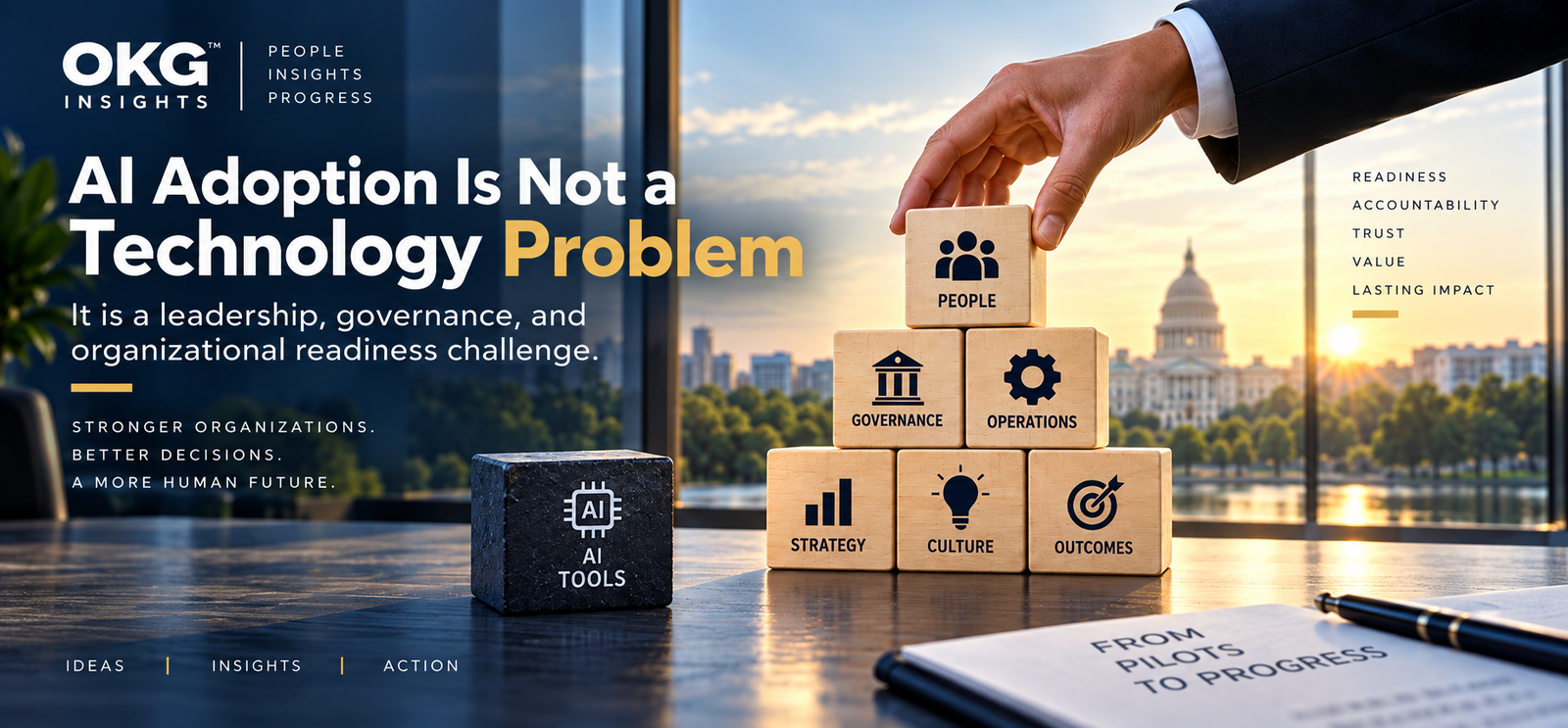

Organizations are moving quickly to adopt artificial intelligence.
AI is showing up in customer service, human resources, finance, operations, cybersecurity, analytics, clinical environments, marketing, procurement, and increasingly in the everyday productivity tools employees already use.
The governance conversation often starts somewhere else.
Organizations begin drafting policies. They establish AI committees. They create approval processes. They debate principles for responsible AI.
Those activities matter. But there is a more fundamental question that should come first:
Does the organization actually know where AI is being used?
Without that visibility, even a well-written AI governance policy has limitations.
An organization cannot effectively govern technology it cannot see.
That makes visibility—not policy—the practical starting point for enterprise AI governance.

AI Governance Starts With Visibility, Not Policy
AI governance is sometimes treated primarily as a compliance or technology matter.
In practice, it is becoming an enterprise operating issue.
Consider how easily AI can enter an organization.
A business unit purchases software that includes new AI functionality.
An employee begins using a generative AI tool to summarize documents.
A vendor introduces an AI-enabled feature into an existing platform.
A department develops an automated decision tool.
A team experiments with an AI agent to perform administrative work.
Another group incorporates machine learning into analytics or forecasting.
Some of these uses may be formally approved. Others may develop gradually through normal business operations.
That creates a governance challenge.
Leadership may believe it has a manageable number of AI initiatives while dozens of additional AI-enabled processes are already operating throughout the organization.
The issue is not necessarily that those uses are inappropriate.
The issue is that the organization may not have enough information to determine which uses create meaningful risk and which do not.
An AI Policy Cannot Govern What the Organization Cannot See
Policies establish expectations.
They can define acceptable use, prohibited activities, documentation requirements, accountability, security expectations, and approval authorities.
But a policy alone does not create operational visibility.
Imagine an organization with an excellent AI policy but no reliable way to identify:
- which AI systems are currently operating;
- what business processes they support;
- what information they access;
- which vendors provide them;
- who owns the use cases;
- which decisions they influence; or
- which systems have changed since their original approval.
The organization technically has AI governance.
Operationally, however, significant blind spots may remain.
The more useful question is not simply:
Do we have an AI policy?
It is:
Can we consistently identify, assess, approve, monitor, and reassess the AI systems being used across the organization?
That is where governance becomes an operating model rather than a document.
The First Step: Build Visibility Into Enterprise AI Use
Before assigning complicated review requirements, organizations need a reliable picture of their AI environment.
That generally starts with an AI inventory.
An AI inventory is not simply a list of software.
It should provide enough information for leaders and governance teams to understand how AI is being used and why the use matters.
At minimum, an organization should be able to identify:
| Governance Question | What the Organization Needs to Know |
|---|---|
| What is being used? | AI system, model, application, feature, agent, or service |
| Why is it being used? | Business purpose and intended outcome |
| Who owns it? | Business owner and, where appropriate, technical owner |
| Where did it come from? | Internally developed system or third-party vendor |
| What information does it use? | Data sources, sensitive information, or protected data |
| What does it influence? | Decisions, recommendations, workflows, communications, or actions |
| Who could be affected? | Employees, customers, patients, applicants, partners, or the public |
| What could go wrong? | Operational, legal, privacy, security, financial, reputational, or human impact |
| How significant is the risk? | Appropriate organizational risk classification |
| What is its status? | Proposed, testing, approved, deployed, restricted, suspended, or retired |
This information creates a foundation for nearly every other AI governance activity.
Without it, governance teams are forced to make decisions with an incomplete picture.
Separate Business Ownership From Technology Ownership
One distinction deserves particular attention.
Who owns the AI use case?
and
Who owns the technology?
Those are not always the same person.
An IT organization might administer an AI platform while a human resources team uses it to support workforce decisions.
A vendor-management group might oversee the contract while an operations department determines how the AI output is used.
A data science team might develop a model while a business leader ultimately determines whether its recommendation affects a customer.
Effective AI governance should make those responsibilities clear.
Technical ownership does not eliminate business accountability.
The people responsible for the business process should understand what the AI is being asked to do, how its output is used, and what happens when that output is incorrect.
Not Every AI Use Case Needs the Same Level of Governance
One of the easiest ways to make AI governance unnecessarily difficult is to treat every AI use the same.
They are not the same.
Using AI to improve the wording of an internal presentation is fundamentally different from using AI to recommend whether someone qualifies for a service, receives an employment opportunity, or is flagged for additional investigation.
The governance process should recognize that difference.
A practical organization might classify AI uses into several levels.
Lower-Risk AI Uses
These may include limited productivity applications where AI assists a person but does not independently make consequential decisions.
Governance may primarily involve acceptable-use requirements, security controls, approved tools, and basic documentation.
Moderate-Risk AI Uses
These may influence business processes, analyze organizational data, generate customer-facing content, or automate portions of workflows.
They may require additional review, testing, documentation, and monitoring.
Higher-Risk AI Uses
These may affect employment, eligibility, healthcare, financial decisions, safety, legal rights, access to services, sensitive personal information, or other consequential outcomes.
These systems may require much stronger controls, formal approval, documented testing, human oversight, legal or compliance review, and ongoing monitoring.
Risk-based governance allows organizations to focus their strongest controls where the potential consequences are greatest.
It also prevents governance from becoming an obstacle to every routine AI experiment.
A Practical AI Governance Workflow
Once the organization has visibility, governance can follow a repeatable operating process.
DISCOVER → REGISTER → ASSESS → REVIEW → APPROVE → MONITOR → REASSESS
1. Discover
Identify where AI is being proposed, purchased, developed, embedded, or already used.
Discovery should not rely exclusively on employees voluntarily reporting AI activity. Procurement, technology inventories, vendor management, security reviews, and application-management processes can also help identify AI use.
2. Register
Capture the use case in a central AI inventory.
Registration creates organizational visibility and establishes an accountable owner.
3. Assess
Determine the purpose, affected stakeholders, data involved, potential consequences, and overall level of risk.
The depth of assessment should reflect the significance of the use.
4. Review
Route the use case to the appropriate reviewers.
Depending on the application, that may include technology, cybersecurity, privacy, legal, compliance, risk, human resources, procurement, clinical leadership, or other business functions.
Not every use case needs every reviewer.
5. Approve
Document who has authority to approve the AI use and under what conditions.
Approval should also identify any required controls, restrictions, testing, or monitoring.
6. Monitor
Governance should not end when the system enters production.
Organizations need mechanisms to identify performance problems, unexpected outcomes, incidents, complaints, data changes, vendor changes, or other emerging risks.
7. Reassess
An AI system that was acceptable when originally approved may not remain acceptable indefinitely.
Models change.
Vendors change.
Data changes.
Business processes change.
Regulations change.
The way employees use the system may change.
Material changes should trigger reassessment.
Executive Visibility Matters
AI governance should ultimately give leadership useful information—not simply generate additional documentation.
Executives generally do not need to review the technical details of every AI system.
They do need enough information to understand the organization’s overall exposure.
An enterprise AI governance dashboard, for example, could show:
- total registered AI use cases;
- new AI use cases awaiting assessment;
- AI systems currently in production;
- number of higher-risk AI applications;
- systems operating under conditional approval;
- outstanding control or remediation items;
- third-party AI systems;
- reported AI incidents;
- systems requiring upcoming reassessment; and
- trends in AI adoption across business functions.
That changes the conversation.
Instead of asking whether the organization “has AI governance,” leadership can see how AI is actually being used, where risk is concentrated, and whether governance activities are working.
Where the NIST AI RMF Fits
Organizations do not have to develop their approach from scratch.
The NIST Artificial Intelligence Risk Management Framework (AI RMF) provides a voluntary framework for managing risks associated with AI.
Its core functions—Govern, Map, Measure, and Manage—provide a useful structure for thinking about accountability, context, assessment, and risk response throughout the AI lifecycle. NIST describes the framework as voluntary, non-sector-specific, and adaptable across organizations and AI use cases.
As of September 2026, NIST also states that AI RMF 1.0 is being revised, reinforcing an important point for organizations: AI governance itself must be capable of evolving as technology, risk, and regulatory expectations change.
The framework should not simply become another document sitting beside the organization’s AI policy.
Its greater value comes from translating its concepts into actual operating processes.
Where ISO/IEC 42001 Fits
ISO/IEC 42001:2023 provides another important reference point.
The international standard establishes requirements for creating, implementing, maintaining, and continually improving an Artificial Intelligence Management System, or AIMS.
Its management-system orientation makes it particularly relevant to organizations trying to integrate AI governance into existing organizational structures, policies, responsibilities, performance evaluation, and continuous-improvement processes.
NIST AI RMF and ISO/IEC 42001 therefore do not necessarily represent competing approaches.
Organizations can use recognized frameworks alongside applicable laws, industry requirements, internal controls, contractual obligations, and existing enterprise risk-management practices.
The objective should be integration.
Creating separate governance processes for every framework or requirement can produce additional complexity without necessarily improving oversight.
AI Governance Should Support Adoption, Not Simply Control It
There is another reason visibility matters.
Good governance should help an organization distinguish between AI uses that require serious scrutiny and those that can move more quickly.
Without a structured process, organizations can drift toward one of two extremes.
The first is too little governance, where AI adoption expands without adequate oversight.
The second is too much governance, where every use of AI is subjected to the same lengthy review process regardless of risk.
Neither approach scales particularly well.
Risk-based AI governance provides another option.
Lower-risk innovation can proceed with appropriate guardrails.
Higher-risk applications receive greater scrutiny.
Leadership gains visibility.
Business owners understand their responsibilities.
And governance resources are concentrated where they provide the most value.
That is a much more sustainable model for enterprise AI adoption.
The Question Leaders Should Be Asking
The most useful AI governance question may not be:
Do we have an AI governance program?
A better set of questions is:
Where is AI being used?
Why is it being used?
Who owns it?
What decisions does it influence?
Who could be affected?
How significant is the risk?
Who has authority to approve that risk?
How will we know if conditions change?
What happens when something goes wrong?
If an organization can answer those questions consistently, many of the other components of AI governance become easier to build.
Policies can establish expectations.
Technology can automate portions of the workflow.
Governance committees can concentrate on significant decisions.
Dashboards can provide leadership visibility.
Monitoring can provide ongoing assurance.
But the foundation remains the same.
Know where AI is being used. Understand what it can affect. Assign accountability. Make deliberate decisions. Monitor what happens next.
AI governance is not about stopping artificial intelligence from entering the organization.
It is about creating enough visibility, accountability, and structure for the organization to make informed decisions about how AI should be used.
That is where responsible AI adoption begins.