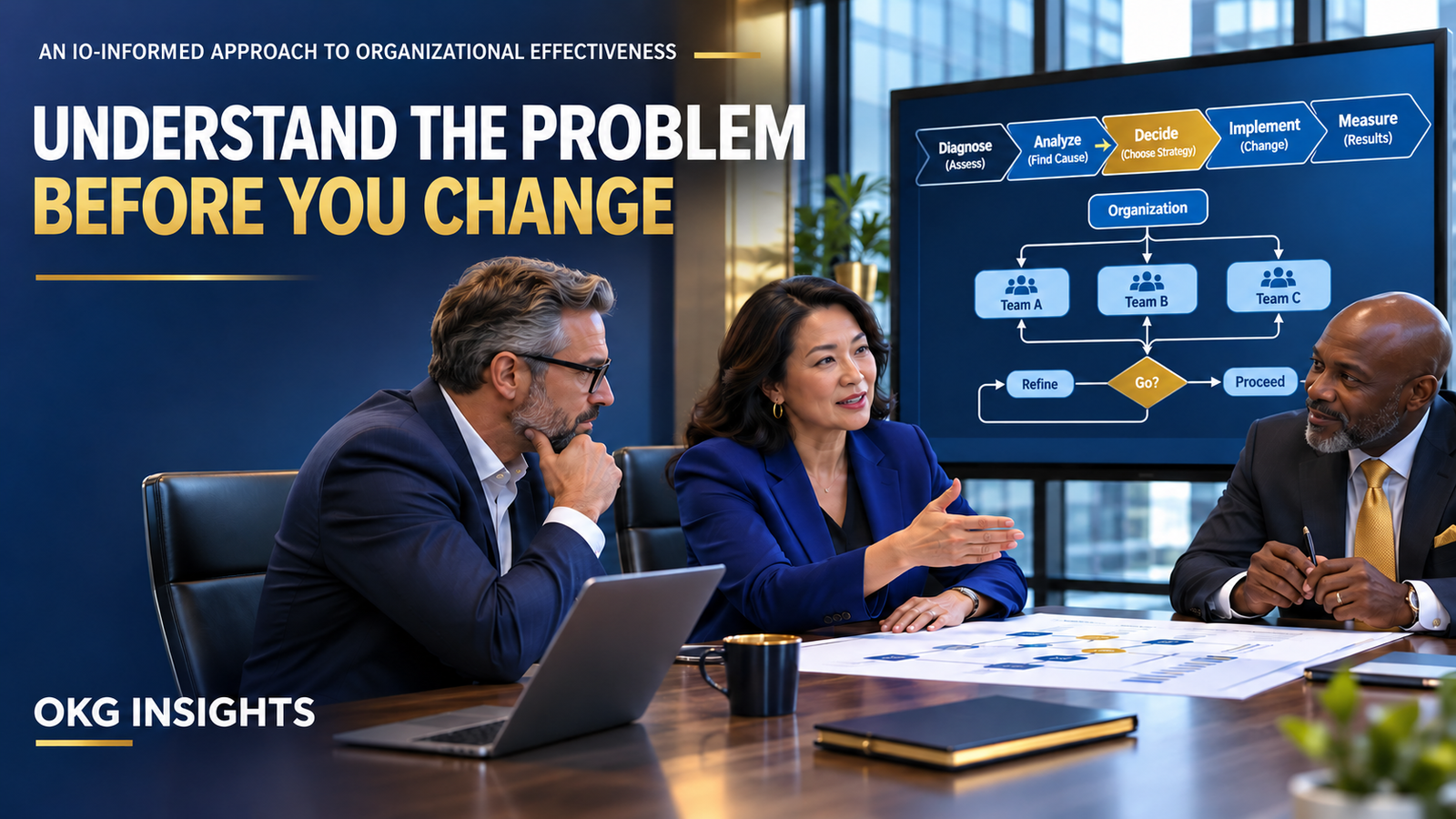
A practical organizational assessment starts with the work and the evidence, not a favorite solution.
When an organization is missing goals, struggling to adopt a new technology, or hearing the same frustrations from employees, leaders often feel pressure to act quickly. A training program, a new system, a reorganization, or a communication campaign may seem like the obvious next step.
Sometimes it is. But a visible problem is not always the underlying problem. If the diagnosis is off, even a well-run initiative can add work without improving results.
Start with what the problem means here
Industrial-organizational psychology offers a useful starting point: be precise about what is being assessed and what the evidence can support. Words such as readiness, alignment, capability, or culture can sound clear while meaning different things to different people. Before treating a score, survey response, or performance measure as an answer, leaders need to know what it represents and whether it is fit for the decision they are making.
That is one reason assessment guidance from the U.S. Office of Personnel Management is worth studying. Its Designing an Assessment Strategy resource is written for hiring and employment assessment, so it is not a general organizational diagnosis manual. Still, it makes reliability, validity, work analysis, and intended use concrete. APA and SIOP’s personnel-selection principles also emphasize that validity evidence must fit the proposed use and the work being assessed. Those principles are about selection procedures, but the measurement discipline is useful more broadly: measure with a purpose, and be clear about the limits of the evidence.
Look at the work, not just the chart
An organization chart can show reporting relationships. It cannot tell you how work moves from one person or unit to another, where decisions wait, what information is missing, or which unofficial steps employees rely on to get the job done. A closer look at tasks, handoffs, authority, workload, and work products can change how leaders understand a problem.
The same is true of data. A metric may show where delays or errors occur, but it may not explain why. Conversations, observation, process records, and outcome measures can each reveal a different part of the picture. When they point in different directions, that is a reason to investigate—not a reason to pick whichever source supports the first proposed fix.
Consider the effects across the organization
Organizations are connected systems. A change that improves one unit’s results may move delays or extra work to another unit. A new tool can change roles, approvals, customer interactions, and the quality checks around a process. Looking at the wider system helps leaders avoid local fixes that create larger problems.
This is where the IO, OD, and change management perspectives can work together. IO contributes research and assessment methods for understanding people and work. Organizational development takes a broader view of organizational effectiveness and development. Change management helps people adopt a defined change. A complex initiative may need all three perspectives, but they answer different questions.
An AI example
Suppose a leader says the organization needs more AI training because adoption is uneven. Training may be part of the answer. But an assessment could reveal that employees do not know which tasks are appropriate for AI, lack access to usable data, are unsure who is accountable for decisions, or are working in a process that makes the tool difficult to use safely.
Those findings point to different responses: clarify decision rights, improve the workflow, address data quality, set practical guardrails, provide training, or combine several changes. The point is not to delay action. It is to choose action that addresses what is actually getting in the way.
A better fit for each organization
There is no single template that can account for every organization’s strategy, culture, history, capacity, and operating conditions. A useful approach brings established methods to the problem, then adapts the response to the organization. It also checks what changed after the intervention and whether the improvement lasted or created new pressures elsewhere.
For leaders, that can make the difference between launching another initiative and making a change that improves the work. For people supporting organizations, the value is in helping leaders understand the issue well enough to choose a response that fits.
If your organization is considering a major technology change, restructuring a function, or trying to resolve a persistent performance issue, start by asking what evidence would change your view of the problem. That question can save time, reduce avoidable disruption, and lead to a better decision.