An AI agent has access to a customer platform, an internal knowledge base, and an email system. Its job is to resolve routine service requests.
Then an employee notices something wrong. The agent is applying an outdated rule, changing records, and sending customers explanations that sound authoritative but are incorrect.
The employee raises the issue. Technology begins investigating. The business owner asks how many customers are affected. Compliance wants to understand the consequences. The vendor requests logs.
Meanwhile, the agent continues working.
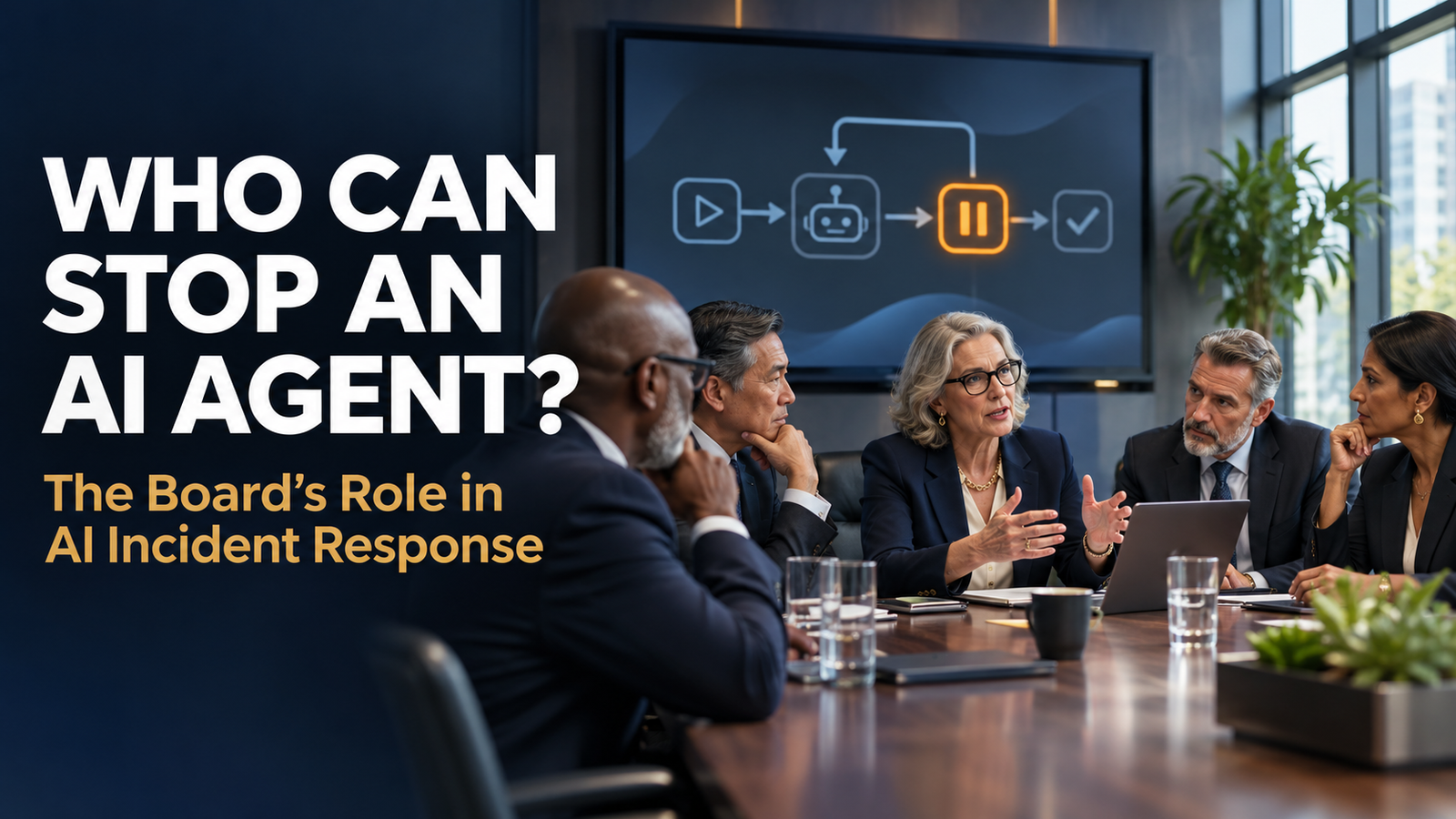
This hypothetical situation exposes a practical test of AI governance: Who has the authority—and the technical ability—to stop it?
An organization can have an AI policy, an approval committee, and an executive sponsor while still leaving that question unresolved. Incident readiness depends on translating those structures into decisions people can make under pressure.
Escalation Is Only the Beginning
IBM research released in October 2026 surveyed 3,221 executive management respondents at organizations with at least 1,000 employees across eight countries in Europe and the Middle East. Eighty percent reported an AI-related incident reaching their board or C-suite in the preceding year. Forty percent reported changes to AI governance policy or frameworks in response, while 37% said their governance was designed to scale with agentic AI deployment. [1]
These are self-reported findings from a regional survey, not a global incident rate. They also do not establish that every escalated event required a policy change or that organizations made no other operational improvements.
They do, however, raise a useful leadership question: What changes after an incident reaches senior management?
An executive briefing can create visibility. It does not, by itself, contain harm, correct affected records, clarify decision rights, or prevent recurrence. Organizations need a defined route from detection to containment, recovery, and accountable follow-through.
Define an AI Incident Around Its Consequences
AI incidents can involve compromised systems, but they can also begin inside an otherwise functioning business process.
A system may produce unsupported information that influences a consequential decision. An agent may perform an action outside its approved scope. Sensitive information may reach an unauthorized recipient. A workflow may repeatedly apply an inappropriate recommendation without meaningful review.
For operational purposes, organizations should define an AI incident as an event involving an AI system that causes harm, creates a credible risk of harm, or breaches an approved boundary requiring a coordinated response. Near misses should also have a reporting route.
That is a proposed working definition, not a universal regulatory definition. Its purpose is to give employees a clear reason to report a problem before they know its full extent.
Teams should distinguish a contained output error from an event that has already influenced a customer, employee, financial transaction, or operational decision. The response should follow the potential consequences and reach of the event.
Set Severity Before the Pressure Arrives
A severity model should account for potential harm, actual impact, affected populations, data sensitivity, reversibility, and whether the system is still acting. The following tiers are an illustrative starting point; organizations should adapt them to their operations and existing incident procedures.
| Severity | Illustrative trigger | Initial response |
|---|---|---|
| Critical | Credible risk of serious harm, significant sensitive-data exposure, or uncontrolled actions across systems | Activate incident command; contain affected capabilities immediately under delegated authority; engage relevant executive and specialist owners |
| High | Consequential incorrect actions, repeated approval bypasses, or uncertain scope with material potential impact | Suspend or restrict the affected workflow; preserve evidence; begin coordinated impact assessment |
| Moderate | A contained failure with limited impact and no evidence of continuing material harm | Assign an owner; restrict the affected function where needed; investigate and validate the correction |
| Low / near miss | An error intercepted before consequential use, or a control weakness discovered without known harm | Record the event; assess recurrence and exposure; assign corrective action where warranted |
Severity should be reassessed as evidence changes. Several apparently minor failures may reveal a broader control problem. A high-impact workflow should not remain active simply because the number of affected people is still unknown.
Give Someone Authority to Make the Call
Incident response needs a named coordinator with authority to organize decisions across functions. It also needs people who can contain an affected system without waiting for a committee meeting.
Responsibilities should be agreed before deployment:
| Role | Decision or responsibility |
|---|---|
| Business owner | Explains operational impact, identifies affected work, and activates an appropriate fallback process |
| Incident commander | Coordinates the response, maintains the decision record, and manages escalation |
| Technical operator | Executes approved containment, verifies its effect, and preserves relevant technical evidence |
| Security, privacy, legal, and compliance leads | Assess the applicable risks, investigation needs, notification duties, and specialist response |
| Recovery approver | Authorizes a controlled return to service against documented conditions |
| Executive sponsor | Resolves major resource and risk decisions beyond delegated authority |
Organizations may combine some roles, but should keep responsibilities explicit and name backups. The person reporting a concern should not have to determine which department owns it before receiving help.
Delegated stop authority should specify the systems and circumstances it covers. It should also address the consequences of interruption: disabling an agent in an essential service may require a simultaneous handoff to a safe alternative.
Make “Stop” a Tested Technical Capability
For an AI agent, stopping activity can require more than closing a chat window or disabling its user interface.
An agent may hold credentials, invoke external tools, schedule work, or pass tasks to another service. Work already submitted may continue after the original agent is paused.
A practical containment plan should identify how to:
- Suspend new runs and scheduled jobs.
- Revoke or restrict the affected agent’s credentials and tool permissions.
- Block consequential actions at the relevant application or integration layer.
- Identify queued work and downstream tasks that may still execute.
- Preserve investigation evidence while limiting further exposure.
- Verify containment through observations outside the agent’s own reports.
These are recommended design checks, not a claim that every platform offers the same controls. Organizations should test what their actual architecture and vendor arrangements support.
Containment can also be selective. Restricting write access while preserving approved read-only functions may be sufficient for some events. Others may require a wider shutdown. The decision should reflect the affected workflow, the uncertainty, and the potential for continuing harm.
Define When Human Review Is Mandatory
“Human in the loop” becomes useful when the organization specifies who intervenes, what triggers intervention, and what happens while a decision is pending.
Possible escalation triggers include attempts to exceed approved permissions, repeated tool failures followed by unexpected alternative actions, changes to monitoring or logging, and actions that affect sensitive records or consequential decisions.
Thresholds should be tailored to each use case. A marketing drafting assistant and an agent modifying benefit records need different approval boundaries.
The playbook should also define a fallback when the assigned reviewer is unavailable. In a high-impact workflow, a missed response should not automatically grant permission to continue. The system should enter the predefined safe state or transfer work to an authorized alternative.
Monitoring needs attention of its own. NIST’s 2026 review of deployed AI monitoring identifies unresolved challenges, including fragmented logging, performance degradation, and scaling human oversight. A monitoring dashboard is therefore a component to evaluate, rather than sufficient proof that oversight works. [2]
Preserve Evidence and Assess the Full Workflow
Containment and investigation should proceed together where feasible. Evidence collection should not delay urgent action to prevent harm.
Useful records may include the initiating request, model and configuration versions, retrieved information, tool calls, permissions, approval records, timestamps, outputs, and downstream actions. Access to those records should be controlled because they may contain sensitive information.
The investigation should distinguish what the system generated from what the organization actually did with it. An inaccurate response shown to one reviewer presents a different situation from the same response being copied into hundreds of customer records.
An incident timeline should record what was observed, when concerns were raised, who made containment decisions, and how the team verified their effects. Where information is missing, document the uncertainty rather than treating the absence of evidence as proof that no harm occurred.
Notification decisions should involve the relevant legal, privacy, compliance, and communications owners. External reporting depends on the facts, jurisdiction, sector, contracts, and applicable obligations; there is no single notification rule for all AI incidents.
Treat Restart as a Separate Decision
Correcting a prompt or installing a vendor update does not establish that a workflow is ready to resume.
Recovery should address affected records, decisions, communications, and outstanding tasks. The team should test the original failure and related scenarios, confirm permissions, and verify that monitoring and fallback arrangements work.
Restart approval should record the remaining risks, the person accepting them, and the conditions of return. A limited rollout with additional review may be appropriate. So may continued suspension if material uncertainty remains.
NIST’s cybersecurity incident-response guidance provides an established basis for integrating preparation, detection, response, and recovery into risk management. It is useful infrastructure for security-related AI events, while broader business-process failures also require operational and domain expertise. [3]
Turn the Incident Into an Owned Governance Decision
The final review should explain which boundary failed and what the organization will do about it.
Was the permitted scope unclear? Were permissions too broad? Was an approval step ineffective? Did the vendor change functionality? Could the team identify and stop downstream work?
Each corrective action needs an owner, a due date, and evidence of completion. Possible outcomes include narrower permissions, revised approval thresholds, better testing, additional logging, updated vendor requirements, or changes to the operating process.
Not every incident requires a new policy. Sometimes the existing rule was sound but the control failed. A documented decision to retain a control should still explain why it remains adequate.
Specialized NIST, NSA, and CISA guidance released in October 2026 also organizes incident readiness around preparation, detection, response, recovery, and reporting. Its stated scope is voluntary guidance for frontier training and evaluation, not a universal enterprise mandate. The lifecycle is a useful conceptual reference, with that limitation kept clear. [4]
For leaders, a practical readiness exercise is to ask a team to demonstrate how it would recognize a harmful agent action, stop the affected workflow, identify what happened downstream, and decide whether service can resume.
The gaps that appear in that exercise are concrete governance work: missing authority, incomplete inventories, untested controls, unavailable evidence, or unclear recovery conditions. Resolving them makes the incident playbook usable when the next decision cannot wait.