Public Sector AI Trends in 2026: What Government Leaders Need to Know
Artificial intelligence in government is moving into a different stage.
For several years, much of the conversation centered on experimentation: What can generative AI do? Where might agencies use it? Which processes could potentially be automated?
In 2026, those questions have not disappeared, but they are being joined by more consequential ones.
How should governments govern AI once it becomes part of everyday operations? Who is accountable for AI-supported decisions? How should agencies procure rapidly evolving technology? What happens to the workforce when AI becomes embedded in routine work? And how can governments capture the benefits of AI without weakening public trust?
These questions matter because public sector AI adoption is accelerating.
The OECD’s 2026 Digital Government Outlook reports that AI is now used in at least one area of government in 35 of the 36 OECD countries examined. Adoption is strongest in internal government processes and public services, although more consequential applications involving policymaking and oversight remain less common.
In the United States, the Government Accountability Office reported that federal agencies more than doubled their use of artificial intelligence between 2023 and 2024. GAO also found that generative AI use expanded particularly rapidly across the federal agencies it reviewed.
The larger story, however, is not simply that governments are using more AI.
It is that artificial intelligence is beginning to affect how public institutions operate.
For leaders, that changes the conversation.
1. AI Governance Is Moving From Policy to Operations
One of the most important public sector AI trends in 2026 is the shift from writing AI principles to actually implementing AI governance.
Many organizations already have responsible AI policies, technology standards, privacy requirements, cybersecurity controls, or acceptable-use guidelines.
The harder question is what happens when an employee wants to introduce an AI system into an actual business process.
Who evaluates it?
Who determines the risk level?
Who approves the data?
Who reviews the vendor?
Who monitors the system after implementation?
And who is accountable if something goes wrong?
These are operating-model questions, not simply policy questions.
NIST’s AI Risk Management Framework provides one useful structure through its four core functions: Govern, Map, Measure, and Manage. NIST is also revising AI RMF 1.0, reinforcing an important point for public organizations: AI governance itself must continue to evolve as technology and risk change.
The organizations that mature fastest will likely move beyond having an AI policy and establish repeatable governance mechanisms such as AI inventories, risk classifications, review processes, approval authorities, monitoring requirements, documentation standards, and escalation procedures.
The question is increasingly becoming:
Can the organization demonstrate how AI is governed throughout its lifecycle?
2. Generative AI in Government Is Becoming Operational
Generative AI remains one of the most visible areas of government technology adoption.
But its use is becoming more practical.
Potential applications include summarizing documents, drafting communications, supporting research, organizing institutional knowledge, assisting employees with information retrieval, analyzing large volumes of material, and improving administrative workflows.
GAO reported that across 11 selected federal agencies with AI inventories, reported generative AI use increased ninefold from 2023 to 2024.
That growth illustrates both the opportunity and the governance challenge.
A generative AI tool used to brainstorm an internal presentation carries a very different risk profile from one being used to summarize case information, assist with benefits decisions, interpret regulations, or communicate directly with the public.
Treating every AI use case the same can therefore create two problems.
Organizations may impose so many controls on low-risk uses that innovation becomes unnecessarily difficult.
Or they may apply too little oversight to AI systems capable of affecting people, services, funding, eligibility, or government decisions.
Effective AI risk management increasingly requires organizations to distinguish between use cases and apply controls proportionate to their potential impact.
3. Agentic AI Could Become the Next Major Government AI Conversation
Generative AI primarily produces content or answers.
Agentic AI goes further.
AI agents can potentially perform sequences of tasks, interact with systems, retrieve information, initiate actions, and coordinate workflows with varying degrees of autonomy.
That makes agentic AI particularly significant for government operations.
Imagine a government service environment in which an AI-enabled system can help a resident determine eligibility, retrieve information across multiple programs, prepopulate forms, identify missing documentation, and guide the person through several administrative steps.
That is very different from a chatbot answering a question.
Deloitte’s 2026 government trends research identifies agentic AI as an emerging opportunity for more personalized and integrated public services, including services that cut across traditional agency boundaries.
But greater autonomy also creates greater governance requirements.
Organizations will need to determine what AI agents are permitted to access, what actions they can initiate, when human authorization is required, how activity is logged, and how errors can be detected and reversed.
For public institutions, the key question may not be whether AI agents become technically capable of completing a task.
It may be:
How much authority should an AI system be allowed to exercise?
4. AI Procurement Is Becoming a Strategic Capability
One of the less visible but increasingly important challenges surrounding AI in government is procurement.
Public organizations often acquire AI capabilities from commercial vendors rather than developing everything internally.
That means procurement decisions can shape an organization’s AI environment for years.
GAO’s 2026 review of federal AI acquisition found several challenges, including difficulty accessing technical expertise to evaluate vendor proposals and difficulty understanding AI-related costs. GAO also found agencies did not routinely collect and share lessons learned from AI acquisitions.
Federal AI procurement guidance has also emphasized issues such as competition, interoperability, data portability, vendor sourcing, performance, and avoiding costly long-term dependence on a single vendor.
This matters because buying AI is not exactly like buying conventional software.
Models change.
Capabilities change.
Pricing structures change.
Vendor terms change.
Underlying models may change even when the user-facing product appears the same.
Agencies therefore need procurement practices capable of evaluating not only what a system does today, but also how the organization will govern upgrades, data access, model changes, performance requirements, exit strategies, and vendor accountability over time.
AI procurement is becoming part of AI governance.
5. Data Readiness May Determine How Far AI Can Scale
Organizations can purchase sophisticated AI technology and still achieve disappointing results.
Why?
Because AI depends on the systems around it.
One of the strongest themes emerging from current public-sector research is the importance of AI readiness, particularly data readiness.
The OECD’s 2026 Digital Government Outlook concludes that successful government AI adoption depends on strong foundations including high-quality and interoperable data, digital infrastructure, procurement models, organizational capacity, and workforce skills. Where those foundations are fragmented, AI becomes much harder to scale successfully.
GAO has identified similar problems in federal data environments. In one 2026 review involving federal eligibility data, GAO found data-quality and interoperability problems that could make it harder for agencies to use AI and other tools to detect errors and improper payments.
This points to a fundamental reality.
AI does not fix weak data governance. It can expose it.
Organizations considering larger AI investments should therefore examine data ownership, quality, classification, interoperability, retention, access controls, and system architecture alongside the AI technology itself.
6. AI Workforce Readiness Is Becoming a Leadership Issue
Much of the AI conversation focuses on technology.
The implementation challenge may be much more human.
Employees need to understand when AI should be used, how it should be used, what information can be entered into a system, when outputs require verification, and where human judgment remains essential.
Managers face a different set of questions.
If AI reduces administrative work, should existing roles change?
Which skills become more valuable?
Which workflows should be redesigned?
How should employee performance be evaluated when human work and AI-supported work become increasingly interconnected?
And how do organizations prevent employees from either distrusting AI completely or trusting it too much?
The OECD identifies workforce skills and organizational capacity as major conditions for scaling government AI, while government trend research increasingly points toward redesigning work rather than simply automating existing processes.
That distinction matters.
Automating a poorly designed workflow can make a bad process move faster.
The larger opportunity is to reconsider the workflow itself.
For leaders, AI workforce readiness should therefore include more than training employees how to use a tool. It should include job design, operating procedures, decision rights, management expectations, workforce planning, and change management.
7. AI Cybersecurity and Privacy Risks Are Expanding
As AI becomes more integrated into government infrastructure, cybersecurity and privacy are becoming inseparable from AI strategy.
Government organizations frequently manage sensitive information involving individuals, public programs, financial activity, infrastructure, health, benefits, regulation, and national or public security.
AI can introduce new risks around data exposure, access, model behavior, third-party systems, malicious manipulation, and information leakage.
GAO reported in March 2026 that federal agencies continue to encounter significant AI-related privacy risks and found gaps in government-wide guidance addressing some of those challenges.
The federal government has also continued expanding its focus on AI-enabled cybersecurity and the security implications of more advanced AI systems.
For organizations, this means cybersecurity teams cannot be brought into AI initiatives only after a system has already been selected.
Cybersecurity, privacy, legal, procurement, data governance, operations, and business leadership increasingly need to participate earlier in the AI lifecycle.
8. Public Trust Could Determine Whether AI Adoption Succeeds
A public-sector AI system can work exactly as designed and still fail institutionally.
That can happen when people do not trust how the technology is being used.
The OECD’s 2026 Trust Survey provides an important warning.
Only around four in ten respondents across participating OECD countries expressed confidence that government use of AI could produce benefits such as more tailored services or lower costs. Confidence was lower when respondents were asked about fairness, transparency, privacy protection, and maintaining human oversight.
This illustrates one of the fundamental differences between AI adoption in government and many commercial environments.
Public institutions require legitimacy as well as performance.
People may reasonably want to know:
Was AI involved in this process?
What role did it play?
Was a human involved?
What information was used?
Can the result be challenged?
Who is accountable?
Not every AI system will require the same level of disclosure. But organizations should determine those expectations deliberately rather than waiting until controversy forces the conversation.
Public trust should be treated as part of AI governance, not merely as a communications issue.
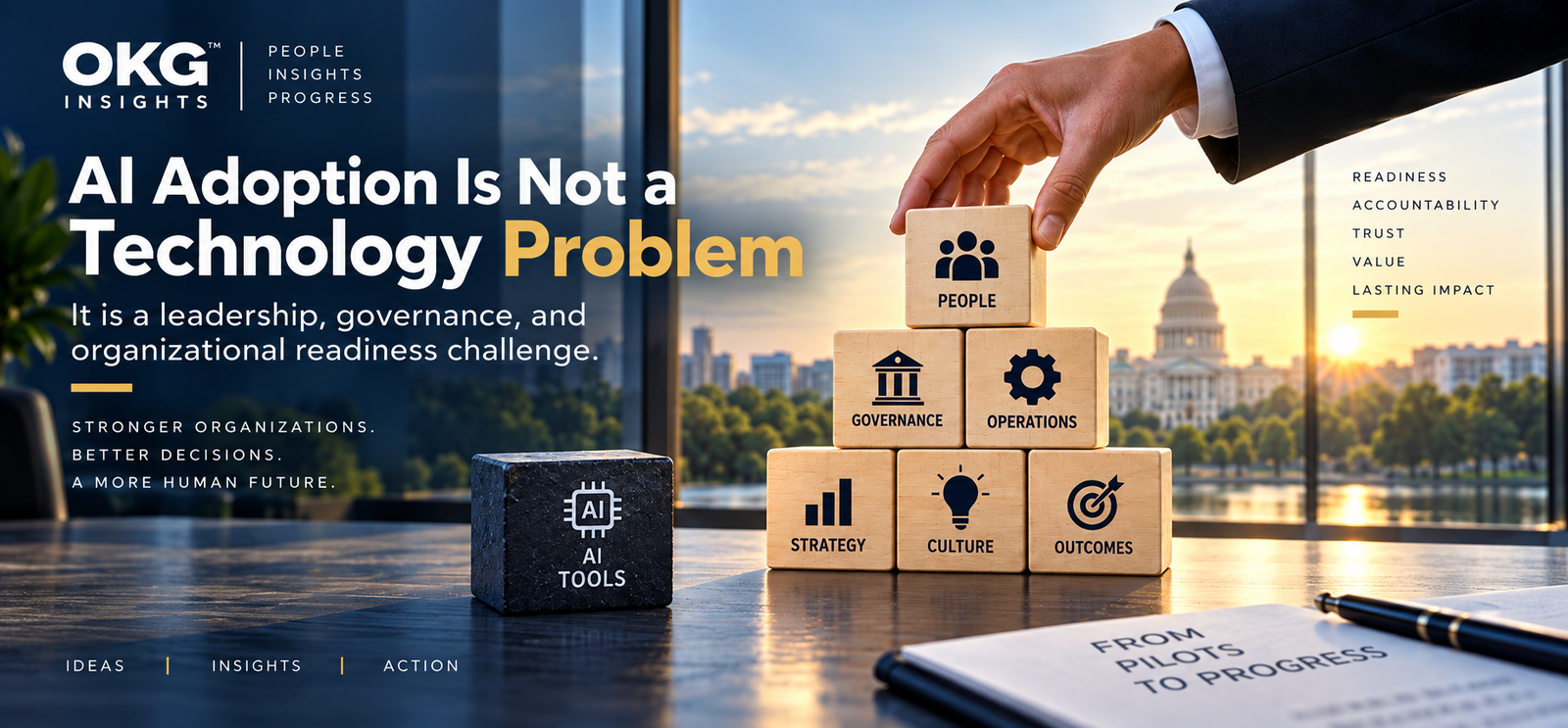
9. AI Readiness Is Becoming More Important Than AI Ambition
The organizations that announce the most AI pilots will not necessarily become the organizations that gain the most from AI.
A more meaningful measure may be whether an organization can move responsibly from experimentation to sustained operational use.
That requires several capabilities working together:
Leadership.
Governance.
Data.
Technology infrastructure.
Cybersecurity.
Procurement.
Legal and compliance support.
Workforce skills.
Change management.
Performance measurement.
And clear accountability.
The OECD has found that while government AI strategies and governance structures have become widespread, the practical conditions required to scale AI remain uneven. It also notes that difficulties measuring AI’s impact can contribute to large numbers of pilots that have limited potential to scale.
That may become one of the defining challenges of the next phase of government AI adoption.
Moving from:
“We have an AI pilot.”
to:
“We have an organizational capability for governing and scaling AI.”
Those are not the same thing.
What Public-Sector Leaders Should Be Asking Now
The most useful question for leaders is probably not:
Where can we use AI?
That question is too broad.
A better set of questions is:
Where could AI create measurable public value?
Which use cases should receive priority?
What risks accompany those uses?
Do we have the data and infrastructure to support them?
Who owns the decision?
What must remain under human control?
How will the system be monitored?
How will employees be prepared?
How will the public know when AI materially affects a service or decision?
And how will we know whether the investment actually improved the outcome?
Those questions turn AI from a technology discussion into an organizational strategy discussion.
The Bigger Picture
Artificial intelligence will likely become part of the normal operating environment of government.
Some uses will be highly visible.
Others may quietly become embedded inside administrative processes, knowledge systems, cybersecurity tools, analytics platforms, procurement systems, and employee workflows.
That makes the decisions being made now particularly important.
The strongest public-sector organizations will not necessarily be those that adopt AI first or deploy the most tools.
They will be the organizations capable of connecting innovation with governance, operational discipline, workforce readiness, strong data foundations, cybersecurity, accountability, and measurable public value.
AI creates significant opportunities for government.
But technology alone will not determine whether those opportunities are realized.
Institutional readiness will.