
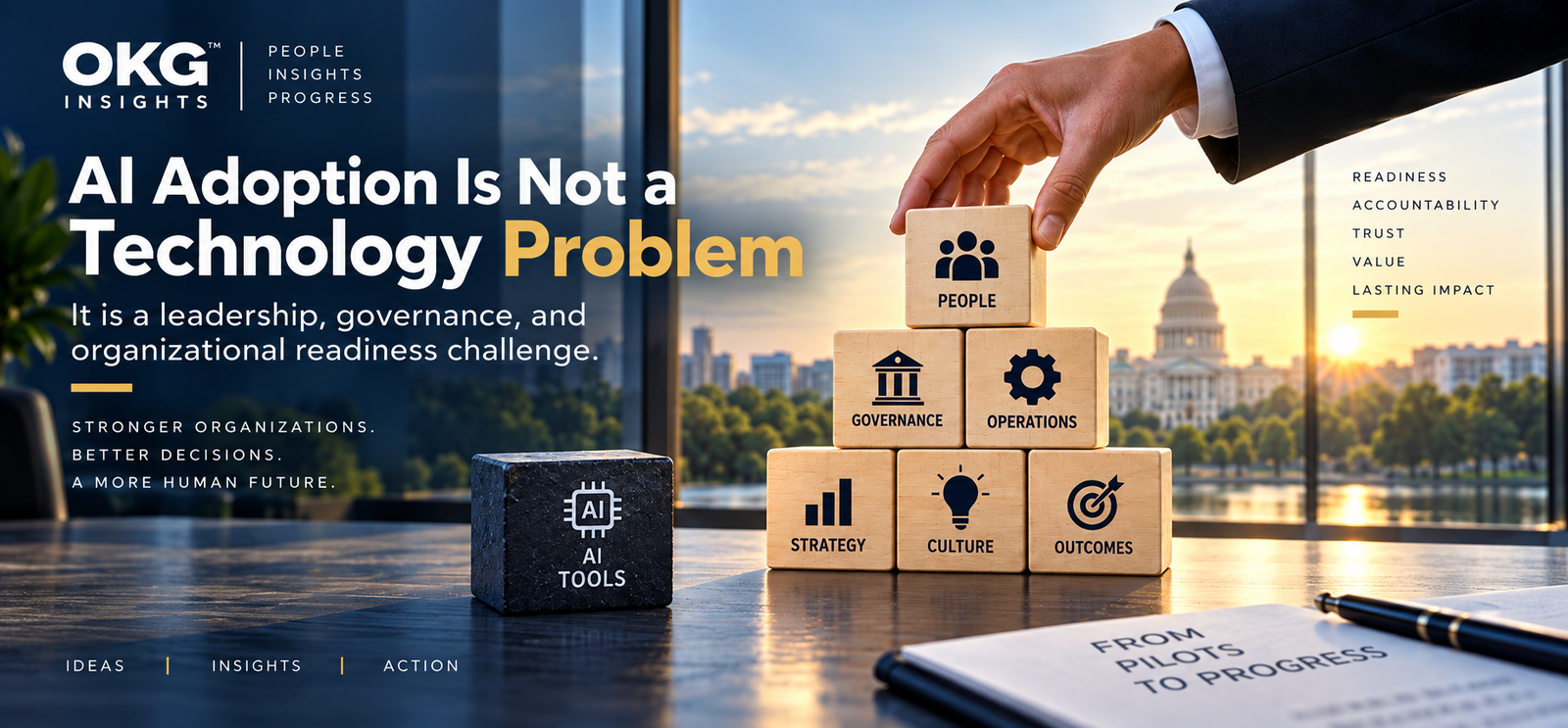
AI Adoption Is Not a Technology Problem
It Is a Leadership, Governance, and Organizational Readiness Challenge
Organizations are buying AI faster than they are redesigning themselves to use it.
That may be one of the defining management challenges of 2026.
Artificial intelligence has moved rapidly into the enterprise. Tools that once required specialized technical teams are now available across operations, finance, human resources, customer service, healthcare, government, compliance, and nearly every other business function.
Adoption, however, is not the same as transformation.
Stanford University’s 2026 AI Index reports that 88% of surveyed organizations used AI in at least one business function in 2025. McKinsey reported a similar level of adoption, yet only 7% of respondents said AI was fully scaled across their organizations.
That difference points to something larger than an implementation gap.
Most organizations can acquire AI. Far fewer have built the leadership structures, governance, workflows, workforce capabilities, data foundations, and decision-making systems needed to use it effectively at scale.
The real challenge is no longer gaining access to artificial intelligence. It is building an organization capable of absorbing it.
This is why AI adoption is not primarily a technology problem.
It is a leadership, governance, and organizational readiness challenge.
The organizations that succeed will not necessarily have the best tools. Instead, they will have the best systems for deciding where AI belongs, how it should be used, who remains accountable, what must change around it, and whether it is actually creating value.
The AI Adoption Paradox
AI tools are becoming easier to acquire at the same time that successful AI adoption is becoming more complex.
That may sound contradictory, but the reason is simple.
Technology can often be deployed faster than an organization can change.
A company may purchase AI licenses in a matter of weeks. In contrast, changing workflows, policies, data practices, employee behaviors, management expectations, governance structures, and decision rights can take months or even years.
As a result, organizations can appear highly advanced because they have AI tools everywhere while still lacking the capabilities required to use those tools well.
This creates an important paradox:
The easier AI becomes to deploy, the more important organizational discipline becomes.
The stakes also rise as AI moves deeper into operations.
An employee using AI to summarize notes presents relatively limited organizational risk. An AI system that analyzes customer complaints, recommends staffing levels, prioritizes cases, evaluates compliance risks, drafts regulatory communications, or initiates business actions creates a different set of questions.
At that point, leaders must think beyond the model itself.
They need to understand how the technology affects decisions, accountability, employees, customers, operations, and organizational risk.
That is where AI adoption becomes an enterprise issue rather than a software issue.
The Technology Is Only the Visible Part
Technology receives most of the attention because leaders can see it.
A vendor can demonstrate a product.
Executives can compare capabilities.
Teams can run pilots.
Procurement can purchase licenses.
IT can deploy applications.
Those activities create visible evidence of progress.
The harder work often happens beneath the surface.
Before an organization scales AI, it needs clear answers about the business problem, ownership, data, risk, oversight, measurement, and long-term accountability.
For example, a team may know that an AI platform can automate part of a process. That does not answer whether the process should be automated, who should approve the change, what information the system should access, or how the organization will respond if the output is wrong.
Likewise, a successful pilot does not automatically answer what happens when thousands of employees begin using the same technology.
Once AI enters a real business process, someone must evaluate the use case, determine its risk, approve access to data, assess the vendor, establish controls, and monitor performance after deployment.
Yet responsibility for those decisions is often fragmented.
Who ultimately owns the outcome?
That is a governance question, not a technology question.
AI Exposes the Organization It Enters
Artificial intelligence does not arrive in a clean environment.
It enters an organization with existing strengths, weaknesses, habits, systems, policies, and problems.
Because of that, AI often exposes issues that were already there.
Poor data governance becomes more obvious when AI needs reliable access to information.
Unclear decision rights become harder to ignore when an AI recommendation requires approval.
Fragmented workflows become more visible once teams attempt to automate them.
Weak knowledge management shows up when an AI assistant cannot find consistent internal information.
Outdated policies become a problem when employees do not know which rules apply to AI-enabled work.
Likewise, workforce gaps become apparent when employees receive powerful tools without enough guidance about when or how to use them.
In other words, AI can magnify the condition of the organization around it.
The OECD reached a similar conclusion in its 2026 work on AI in government. Its research emphasizes that successful scaling depends on strong data foundations, digital infrastructure, workforce skills, procurement capability, governance, and organizational capacity.
The lesson applies far beyond the public sector.
An organization with clear accountability, mature data practices, disciplined operations, capable leadership, and strong governance is better positioned to absorb AI.
An organization without those foundations may simply automate existing dysfunction.
Leadership Is the First AI Capability
Many organizations begin AI adoption by asking technical questions.
Which platform should we use?
Should we build or buy?
Which model performs best?
How many licenses do we need?
Those questions matter, but they are not the first questions leaders should answer.
Leadership must begin with purpose.
What organizational outcome are we trying to improve?
Where does AI fit within the strategy?
Which problems are important enough to solve?
What level of risk are we willing to accept?
Where should human judgment remain essential?
How will we know whether the investment created value?
Without that clarity, AI programs can quickly become collections of unrelated experiments.
One department launches a chatbot.
Another purchases an analytics product.
Employees begin using generative AI independently.
Operations identifies automation opportunities.
Cybersecurity introduces controls.
Legal raises concerns.
Executives then ask why the organization has so much AI activity but so little measurable impact.
Everyone may be doing something with AI.
That does not mean the organization has an AI strategy.
AI activity is not the same as AI capability.
Research from McKinsey reinforces this point. Its work on organizations capturing value from generative AI found that leadership involvement and workflow redesign are associated with stronger reported business impact.
That finding matters because it shifts the conversation.
AI value does not come from technology alone.
Leadership choices shape where that value can emerge.
Governance Is Not the Brake on AI
Governance is sometimes treated as the part of AI adoption responsible for slowing things down.
That interpretation misses its purpose.
Strong governance should help an organization answer a better question:
How can we move forward responsibly and consistently?
Good governance creates the conditions for scale.
It clarifies who can approve a use case.
It establishes how risk is assessed.
It defines what documentation is required.
It determines when legal, privacy, cybersecurity, compliance, or other functions should participate.
It establishes human oversight.
It creates monitoring expectations.
Most importantly, it makes decision-making repeatable.
NIST’s AI Risk Management Framework reflects this broader view. Its four functions — Govern, Map, Measure, and Manage — emphasize ongoing responsibility across the AI lifecycle.
That lifecycle perspective is critical because AI systems do not remain static.
Models change.
Data changes.
Vendors update products.
Employees find new uses.
Regulations evolve.
Organizational priorities shift.
Therefore, governance cannot end when a system goes live.
It must continue as the system operates.
A Policy Is Not an Operating Model
Many organizations will eventually have an AI policy.
That is useful, but it is not enough.
A policy may explain what employees should or should not do. It does not necessarily show how decisions are made when a real use case moves through the organization.
Operational governance requires more.
For instance, leaders need to know how an AI proposal moves from idea to approval.
They need clarity about when a use case requires legal review, when privacy or cybersecurity should participate, who owns the business outcome, how vendors are evaluated, and who monitors performance after implementation.
The organization also needs a clear response when something goes wrong.
Someone must have authority to stop, modify, or escalate the system.
These are not policy-writing questions.
They are operating-model questions.
As AI programs mature, organizations will increasingly be judged not by whether they have an AI policy, but by whether they can demonstrate how AI decisions are actually made.
Organizational Readiness Comes Before Scale
One of the most costly assumptions leaders can make is that technical readiness equals organizational readiness.
It does not.
A technology team may be capable of launching an AI tool long before the rest of the organization is prepared to use it responsibly.
That creates a readiness gap.
AI readiness should be evaluated across several connected areas.
Strategic readiness asks whether the organization knows what it wants AI to accomplish.
Governance readiness examines whether decision rights, approval processes, risk thresholds, and monitoring responsibilities are clear.
Data readiness focuses on whether information is accurate, accessible, secure, properly owned, and suitable for AI-enabled work.
Process readiness looks at whether the organization actually understands the workflow it wants to change.
Workforce readiness examines whether employees and managers have the skills, expectations, and support required to work differently.
Finally, measurement readiness determines whether leaders can tell if AI improved the outcome.
These areas depend on one another.
Weak data can undermine a strong model.
Unclear governance can delay an otherwise valuable use case.
Poorly designed workflows can limit productivity gains.
Likewise, weak adoption can turn a technically successful system into an operational failure.
AI scale depends on the surrounding organization.
Workflow Redesign Is Where Much of the Value Lives
Organizations often place AI on top of an existing process and call the result transformation.
Consider a process with 18 steps.
Employees transfer information between systems.
Several approvals exist because of decisions made years ago.
Data gets entered more than once.
Reports require manual assembly.
Employees spend hours finding information.
Then AI is introduced into Step 11.
That step becomes 40% faster.
The organization reports an AI productivity gain.
Yet the other 17 steps remain unchanged.
That may be useful automation, but it is not necessarily transformation.
A more valuable conversation begins with the entire process.
Do all 18 steps still need to exist?
Could some approvals disappear?
Could information be captured once instead of several times?
Could employees focus on exceptions rather than routine transactions?
Could decisions move earlier in the process?
Could AI identify problems before they reach the end?
Once leaders begin asking those questions, AI becomes a catalyst for operating-model improvement.
McKinsey’s research supports this view. Workflow redesign was among the organizational practices most strongly associated with reported financial value from generative AI.
However, relatively few organizations had fundamentally redesigned workflows around the technology.
That gap may represent one of the largest unrealized opportunities in AI adoption.
Organizations are introducing AI into work.
Far fewer are redesigning work around what AI makes possible.
AI Transformation Is Also Workforce Transformation
AI adoption is often discussed in terms of labor reduction.
That is only one possible outcome.
A more strategic question is:
How should the organization use the capacity AI creates?
Suppose an employee spends six hours each week assembling information that AI can now prepare in 30 minutes.
The organization has created capacity.
What happens next?
The employee could perform deeper analysis, spend more time with customers, manage complex cases, improve quality, solve exceptions, or take on higher-value responsibilities.
Alternatively, the organization could simply expect more output from the same role.
Those choices determine whether AI becomes a productivity tool or a broader transformation tool.
The World Economic Forum’s Future of Jobs Report 2025 found that employers viewed skills gaps as the most common barrier to business transformation. Nearly 40% of job skills were expected to change by 2030.
PwC’s Global AI Jobs Barometer also found that skill requirements are changing faster in occupations with higher exposure to AI.
These findings make one point clear.
AI adoption cannot belong only to IT.
Human resources, operations, learning and development, risk, legal, finance, compliance, data, technology, and business leadership all have roles to play.
AI changes work.
When work changes, organizations change.
Training Is Not the Same as Workforce Readiness
Organizations also need to distinguish between AI training and AI workforce readiness.
Training teaches employees how to use the tool.
Readiness prepares employees to work differently.
Prompting skills, summarization techniques, and basic AI literacy certainly matter. However, employees also need to know when AI should not be used, which information can enter a system, when outputs require verification, and where human judgment remains essential.
Managers face an even larger shift.
They will increasingly need to manage workflows that combine human and AI contributions.
That means deciding which work should be automated, which should be augmented, which should remain human, and how quality should be assessed.
Managers will also need to think differently about performance.
If AI contributes to the output, what does strong employee performance look like?
If employees can complete routine work faster, how should their roles evolve?
If AI produces a recommendation that conflicts with an employee’s judgment, what should happen next?
These are management questions.
They are not simply technology questions.
Decision Rights May Be the Most Underestimated AI Issue
As AI becomes more capable, organizations will need to pay far more attention to decision rights.
Imagine an AI system that identifies a problem with 92% confidence.
Should the system act?
Should an employee review the result?
Should a manager approve the action?
Should the threshold change depending on the consequence of the decision?
The answer may vary by use case.
That is exactly why organizations need clear decision structures.
This issue becomes even more important with agentic AI.
AI agents can perform sequences of tasks rather than simply respond to prompts. They may retrieve information, interact with software, trigger workflows, communicate with systems, or initiate transactions.
The technical question is whether an AI agent can perform an action.
The organizational question is whether it should.
That distinction changes everything.
Organizations will need to decide what AI can access, what actions it can initiate, when human authorization is required, and how errors can be reversed.
As AI gains more autonomy, human decision rights become more important, not less.
AI Requires an Operating Model
Eventually, organizations need a reliable way to move AI from experimentation into normal operations.
That requires an AI operating model.
No single structure will work for every organization. Still, mature organizations will need clear ownership across strategy, governance, business use cases, technology, risk, adoption, and value measurement.
Executive leadership should connect AI priorities to organizational priorities.
Governance functions should establish clear requirements without becoming detached from operational reality.
Business leaders need ownership of the actual outcomes.
Technology teams need defined responsibility for platforms, architecture, integration, and support.
Risk functions must understand how legal, privacy, cybersecurity, regulatory, operational, reputational, and financial concerns intersect.
At the same time, someone must own adoption.
Deployment without adoption creates little value.
Finally, the organization needs a way to measure whether the investment improved performance.
Without those responsibilities, AI programs can fall into what might be called AI accountability fog.
Many people participate.
No one clearly owns the result.
The Five Systems That Determine AI Adoption
A useful way to think about AI maturity is to stop viewing AI as a collection of tools and start examining the systems around those tools.
1. The Strategy System
This system determines where AI should be used.
It connects organizational priorities to actual use cases and prevents the AI portfolio from becoming an uncontrolled collection of experiments.
2. The Decision System
This system determines who has authority.
It defines ownership, approvals, escalation paths, human oversight, and decision rights.
3. The Governance System
This system determines how AI can be used responsibly.
It covers risk, security, compliance, data, vendors, testing, documentation, and monitoring.
4. The Work System
This system determines how AI changes operations and people.
It includes workflow redesign, job design, skills, adoption, management practices, and change management.
5. The Learning System
This system determines whether AI improves over time.
It includes measurement, feedback, benefits realization, incident learning, monitoring, improvement, and decisions about when an AI application should change or retire.
Technology operates across all five systems.
It does not replace them.
Tool-First Organizations and System-First Organizations Think Differently
A tool-first organization begins with the product.
A system-first organization begins with the outcome.
Tool-first leaders ask which AI to buy.
System-first leaders ask which organizational problem matters enough to solve.
Tool-first organizations measure licenses and users.
System-first organizations measure improved outcomes.
Tool-first organizations ask what the model can do.
System-first organizations ask what the model should be allowed to do.
Tool-first organizations ask whether a process can be automated.
System-first organizations ask whether the process should still exist in its current form.
That difference is more than language.
It reflects organizational maturity.
Beware of AI Adoption Debt
Moving too quickly can create another problem: AI adoption debt.
The idea is similar to technical debt.
Organizations make short-term decisions that seem efficient now but become costly to manage later.
AI adoption debt develops when deployment moves faster than governance, ownership, measurement, workforce readiness, and operational design.
For example, hundreds of employees may begin using AI without clear guidance.
Multiple departments may purchase overlapping tools.
Pilots may launch without performance measures.
Business owners may remain unclear.
Vendor contracts may lack strong data protections.
Automated processes may operate without defined human oversight.
Employees may create unofficial workarounds because approved tools do not meet their needs.
Any one of these issues may seem manageable.
Together, however, they can create a fragmented AI environment that becomes difficult to govern, secure, measure, and improve.
Speed matters.
So does discipline.
In many cases, disciplined adoption creates more durable speed.
Measure Outcomes, Not AI Activity
Organizations naturally measure what is easiest to count.
AI users.
Licenses.
Prompts.
Pilots.
Training completions.
Use cases.
Those numbers can tell leaders whether activity exists.
They do not necessarily show whether AI created value.
Better measurement connects the technology to an operational outcome.
Did cycle time improve?
Did quality increase?
Did errors decline?
Did employees spend less time on low-value work?
Did customer service improve?
Did risk decrease?
Did decision quality improve?
Did costs change?
Did the entire process perform better?
Those are much more important questions.
NIST places measurement directly within AI risk management and emphasizes continuous assessment and monitoring.
Organizations should apply the same discipline to business value.
An AI application should not survive indefinitely simply because the organization deployed it successfully.
It should continue because it remains useful.
AI Activity Does Not Equal AI Maturity
Recent public-sector experience provides a useful example.
In March 2026, the U.S. Government Accountability Office reviewed AI management at the Internal Revenue Service. The agency had 126 active AI use cases in its inventory as of June 2025.
However, GAO also identified issues involving workforce skills, information quality, strategic management, and the completeness of the AI inventory.
Among other findings, GAO reported that the IRS lacked a workforce plan designed to identify and address AI-related skill needs.
That example matters because it shows how easily organizations can confuse volume with maturity.
A large number of use cases indicates activity.
It does not necessarily prove readiness.
The same principle applies across industries.
AI maturity depends on whether the organization can manage, govern, scale, measure, and improve what it deploys.
The Executive Conversation Must Change
Executives do not need to become machine-learning engineers.
They do, however, need to become capable AI decision-makers.
That means executive discussions must move beyond product demonstrations.
Leaders need to understand the business problem, expected value, risk, accountability, workforce impact, workflow implications, and measurement plan.
They should also ask what happens if the vendor changes the model, the regulatory environment shifts, the system underperforms, or employees begin using the technology in ways no one anticipated.
Those conversations move AI into the domain where it belongs:
strategy and management.
What Successful AI Organizations Will Do Differently
The most successful AI organizations will not have one defining characteristic.
They will build a combination of capabilities.
They will connect AI to strategy rather than chase every new tool.
They will redesign workflows instead of simply adding AI to existing processes.
They will establish clear decision rights.
They will apply governance according to risk.
They will strengthen data foundations.
They will prepare managers as well as employees.
They will treat workforce change as part of implementation.
They will measure outcomes rather than activity.
They will learn from failures.
They will retire AI applications that no longer create value.
Most importantly, they will build systems that can adapt as the technology changes.
That last point matters because the AI tool an organization chooses today may not be the one it uses three years from now.
Models will change.
Platforms will change.
Costs will change.
Capabilities will change.
Regulations will change.
A strategy built around one tool can become outdated very quickly.
An organization built around strong decision-making can adapt.
The Sustainable Advantage Is Not the Model
There will always be another model.
A faster one.
A cheaper one.
A more capable one.
A new platform.
A new agent.
A new interface.
Technology advantages can disappear quickly.
Organizational capabilities are harder to copy.
The ability to identify the right problems.
The ability to redesign work.
The ability to coordinate across functions.
The ability to govern risk without stopping innovation.
The ability to mobilize people.
The ability to measure value.
The ability to learn.
Those capabilities create a more durable advantage.
And that may be the central lesson of enterprise AI adoption:
The organizations that succeed will not necessarily be the ones with the best AI tools. They will be the ones with the best systems for deciding how those tools should be used.
AI Adoption Is an Organizational Capability
Artificial intelligence is often described as transformative technology.
That description is incomplete.
Technology creates the possibility of transformation.
The organization creates the transformation itself.
An AI model cannot decide an organization’s risk tolerance.
It cannot resolve competing priorities between business units.
It cannot determine the right accountability structure.
It cannot define how employees should work together.
It cannot decide which organizational values should take priority when goals conflict.
Those remain leadership responsibilities.
For that reason, organizations should not delegate AI adoption entirely to IT, innovation teams, consultants, vendors, or data scientists.
Each of those groups plays an important role.
Still, AI adoption crosses the enterprise.
It touches strategy, operations, finance, governance, risk, legal, cybersecurity, human resources, data, technology, and leadership.
The real challenge is connecting those functions into a coherent system capable of making good decisions.
The Question Leaders Should Be Asking
For several years, leaders have asked:
How quickly can we adopt AI?
That question is becoming less useful.
A better question is emerging:
How effectively can our organization absorb AI?
That is a much more demanding test.
It measures organizational capability rather than technological enthusiasm.
As AI becomes more capable, more autonomous, and more deeply embedded in everyday work, that capability will matter even more.
The next phase of AI adoption will not be won through tool accumulation.
It will be won through leadership judgment, disciplined governance, organizational readiness, workforce adaptation, operating-model design, and better decision-making.
AI may be the catalyst.
But the organization is still the system.